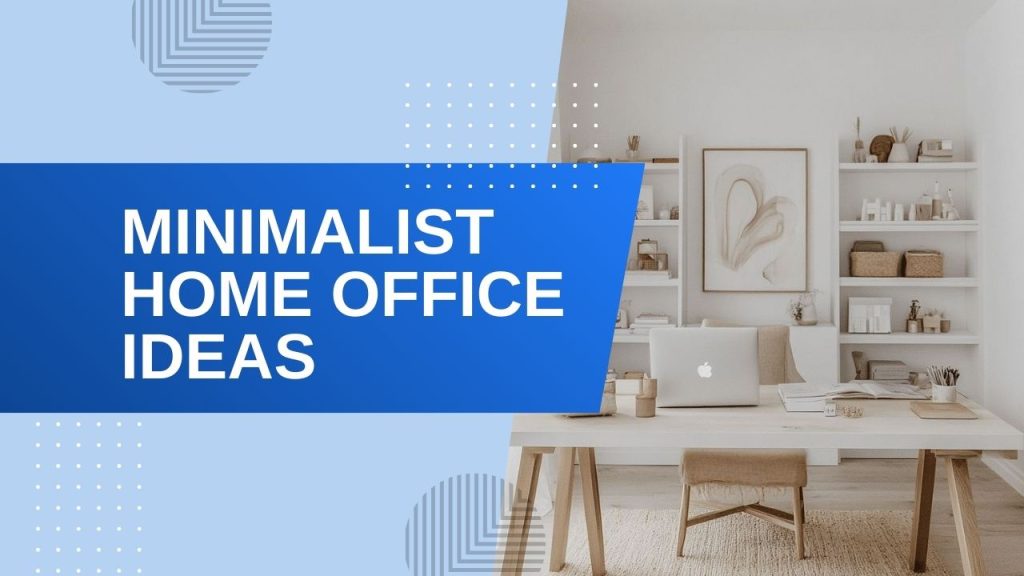
If you’re dreaming about a minimalist home office, you’re not just chasing aesthetics. You’re chasing clarity. Focus. Breathing room.
A well-designed minimalist workspace removes distractions and highlights only what truly matters. Clean lines. Neutral tones. Functional furniture. When done right, a minimalist office feels calm, modern, and incredibly intentional. This isn’t about owning less — it’s about being deliberate with what you keep.
This guide is built to give you both the inspiration and the practical roadmap. Whether you’re squeezing a small home office into a studio apartment corner or redesigning a full dedicated room, you’ll find ideas here that actually work.
Let’s start with the styles that might be calling your name — then we’ll get into the how.
| What You Want | Best Style to Explore | Key Feature |
| Warm, cozy feel | Japandi or Scandinavian | Light wood, muted earth tones |
| Bold, high-contrast look | Monochrome minimalist | Black & white, matte finishes |
| Raw, textured vibe | Industrial minimalist | Metal accents, concrete, open shelving |
| Bright, airy atmosphere | All-white workspace | Hidden storage, maximum light |
| Modern & clean | Modern monochrome | Sleek surfaces, minimal accessories |
Minimalist Home Office Inspiration Gallery (Style Themes)
Before you buy a single piece of furniture or repaint a wall, it helps to know which visual language speaks to you. These are the minimalist workspace inspiration styles getting the most attention heading into 2026 — and they’re all distinct enough that you should be able to feel a pull toward one pretty quickly.
Scandinavian Minimalist Office Design
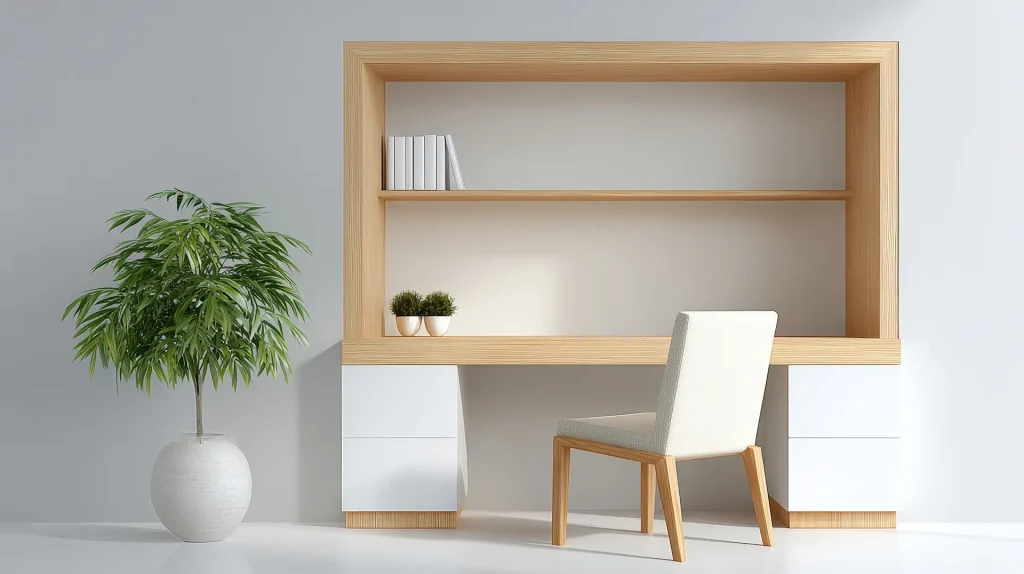
This is the style that started it all for most people. Think light birch or oak desks, white walls, and soft neutral textiles like a linen desk pad or a cream-colored rug. Scandinavian office design leans hard into natural light — the assumption is that a well-lit, simply furnished room is its own reward.
The key is restraint. Decor exists, but it earns its place. A single plant. A framed print with thin white matting. That’s the whole mood.
Modern Monochrome Workspace
Black and white. Full stop. Matte black office decor paired with a crisp white desk creates a high-contrast, incredibly sleek setup that photographs beautifully and feels seriously professional to work in. The trick is keeping textures varied — matte surfaces, brushed metal accents, and smooth desktop accessories so it doesn’t feel sterile.
This is the aesthetic workspace for people who love visual tension and clean edges.
Japandi-Inspired Home Office
Japandi is what happens when Japanese wabi-sabi simplicity marries Scandinavian hygge, and honestly, the result is stunning. Low-profile furniture. Organic textures like bamboo, linen, and raw wood. Earth tone office decor in warm beige, dusty sage, and warm gray.
If you want a workspace that feels meditative and unhurried, Japandi is your answer. It’s the minimalist style that feels the most human.
Industrial Minimalist Office
Not everyone wants soft and cozy. If you’re drawn to exposed concrete walls, black metal shelving, and a functional-first attitude, industrial minimalism might be your vibe. The palette is neutral — grays, blacks, aged whites — but the textures are raw and deliberate.
Streamlined shelving and a no-frills layout make this style surprisingly easy to pull off in a spare room or basement office.
Cozy Minimalist with Warm Wood Accents
This one surprises people. Minimalism doesn’t have to be cold. Warm oak or walnut finishes, soft beige and cream tones, and layered lighting create a workspace that’s both beautifully simple and genuinely comfortable. Think of it as the “I want to actually enjoy sitting here” option. One or two curated decorative elements — a small ceramic dish, a trailing pothos — keep it from feeling bare.
Ultra-Clean All-White Workspace
White desk. White shelving. White walls. Hidden everything. This is the clean workspace aesthetic taken to its logical extreme, and when it’s done right, it’s breathtaking. The secret is quality materials — cheap white furniture turns yellow and looks clinical. Invest in the right desk here, and the simplicity does all the work.
Why a Minimalist Home Office Boosts Focus and Productivity
Here’s something that took me too long to understand: visual clutter isn’t just annoying — it’s cognitively expensive. Every object in your field of view requires a small amount of mental processing. A messy desk isn’t just messy. It’s a constant low-level drain on the attention you need for actual work.
Research in environmental psychology suggests that cluttered spaces elevate cortisol levels — the stress hormone. A calm office environment does the opposite. It signals to your brain that things are under control, which makes it easier to settle into deep, focused work.
The Psychology of Negative Space
Designers talk a lot about negative space — the empty areas in a composition. In a minimalist home office, that empty desk surface or bare wall isn’t wasted. It’s intentional. The brain interprets open space as permission to think freely. It’s the visual equivalent of a deep breath.
This is especially true for remote workers. When your home is also your office, visual boundaries matter. A clutter-free workspace tells your brain: this zone means focus mode.
Less Stuff, Fewer Decisions
Decision fatigue is real. When you minimize the number of objects, tools, and choices in your workspace, you conserve mental energy for the work that actually matters. This is why so many high-performers swear by stripped-down, simple office design — it’s not about aesthetics. It’s a performance strategy.
If you want to go deeper on this idea, our guide to deep work techniques connects the dots between your physical environment and your capacity for sustained concentration. Worth a read before you start redesigning.
The Remote Work Angle
Working from home introduces a unique set of distractions that a traditional office doesn’t have — laundry piling up in the background, the kitchen three steps away, deliveries at the door. A distraction-free workspace that’s visually contained and intentionally designed acts as a mental anchor. When you sit down at a clean, organized desk, the signal is clear: it’s time to work.
Minimalist Home Office Layout Ideas for Small and Large Spaces
Layout is where most minimalist home offices succeed or fail before a single item is purchased. You can have the most beautiful neutral office decor in the world and still feel cramped and chaotic if the desk is in the wrong spot.
Desk Placement: The Natural Light Rule
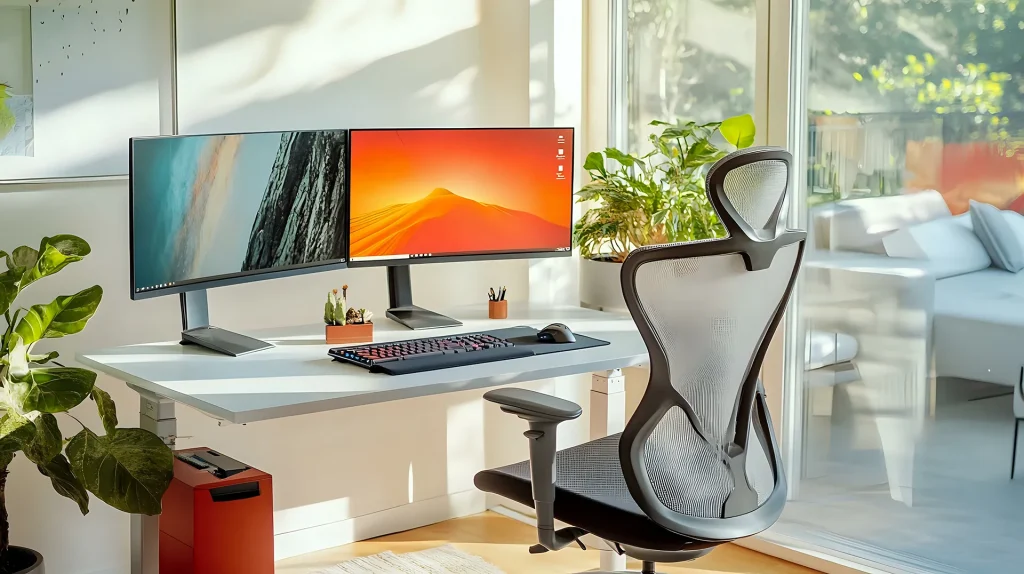
Natural light should be your first layout decision, not an afterthought. Position your desk so that light comes in from the side — either left or right. Facing directly into a window creates glare on your screen; sitting with your back to it casts your own shadow over your work. Side lighting is the sweet spot.
If your only window faces your screen directly, a sheer curtain diffuses the light beautifully without blocking it entirely.
Wall-Facing vs. Window-Facing Setups
- Wall-facing desk: Keeps distractions out of your eyeline. Great for deep work. Can feel slightly enclosed, so use light colors on the wall in front of you.
- Window-facing desk: Gives you a view, which can be energizing — but manage glare with a quality monitor or adjustable blinds. Works well in a bright, airy setup.
- Room-facing desk: Best for people who have video calls frequently. Your face is well-lit, and the background behind you is controlled. Also great if you like to see the full room while working.
Corner Layouts Done Right
A corner desk setup can be brilliant or a clutter magnet — and the difference is usually discipline. In a minimalist home office, a corner layout works well when one arm of the desk is used for primary work and the other is kept nearly empty. Resist the urge to fill every surface. The empty L is part of the design.
Small Spaces and Apartments
If your “office” is a corner of a studio or a nook carved out of a living room, floating desk ideas are your best friend. A wall-mounted floating desk clears floor space, keeps the area feeling open, and can be styled beautifully with a few minimal wall shelves above it. The key is maintaining open walkways around it so the space never feels like it’s closing in on you.
For more specific small-space tactics, I’ve spent a lot of time on this one — check out these 15 brilliant small home office solutions for ideas that actually work in tight square footage.
Defined Zones in Open Floor Plans
Open-plan living spaces are tricky for remote workers. The lack of walls is great for light, but it destroys the psychological separation between work and home. In a modern home office within an open plan, use these tricks to define your zone:
- A rug under the desk area to visually anchor the workspace
- A low bookcase or open shelving unit as a soft divider
- Consistent lighting (a dedicated desk lamp) that signals “work zone”
- Facing the desk away from the main living area when possible
Clean Desk Setup Inspiration (Minimalist Desk Essentials Only)
Let me share something embarrassing. I once counted 23 objects on my desk. Twenty-three. Among them: a broken stapler I hadn’t used in months, three pens I didn’t like writing with, and a decorative cactus that had died but I hadn’t acknowledged it yet. The cactus was somehow a metaphor for the whole situation.
A clean desk setup isn’t about having a sparse desk — it’s about having an intentional one. Every object should earn its spot.
What Actually Belongs on a Minimalist Desk
- Your laptop or monitor — the primary tool, positioned at eye level
- A quality task lamp for focused lighting (more on this below)
- One notebook or notepad — analog thinking still beats typing for some of us
- A single writing instrument you actually like using
- One intentional “statement object” — a small plant, a ceramic mug, something that feels personal without being cluttered
That’s it. Everything else belongs in a drawer, a cabinet, or the bin.
The Cable Management Problem
Nothing kills a clean desk aesthetic faster than a spaghetti tangle of cables. This is the single most common reason minimalist setups fall apart. The good news: it’s completely solvable with proper cable management.
A few things that actually work:
- Cable clips or adhesive cable channels along the back edge of the desk
- A cable management box under the desk to hide power strips
- Wireless peripherals where possible — keyboard, mouse, charging pads
- Velcro cable ties (not zip ties — you’ll need to adjust these)
- A monitor arm, which lifts your screen and eliminates the monitor stand cable cluster
We’ve gone deep on this topic — the full breakdown of cable management solutions for your home office covers everything from budget tape-and-clip setups to built-in desk raceways. Bookmark it. You’ll want it.
Monitor Stands and Visual Hierarchy
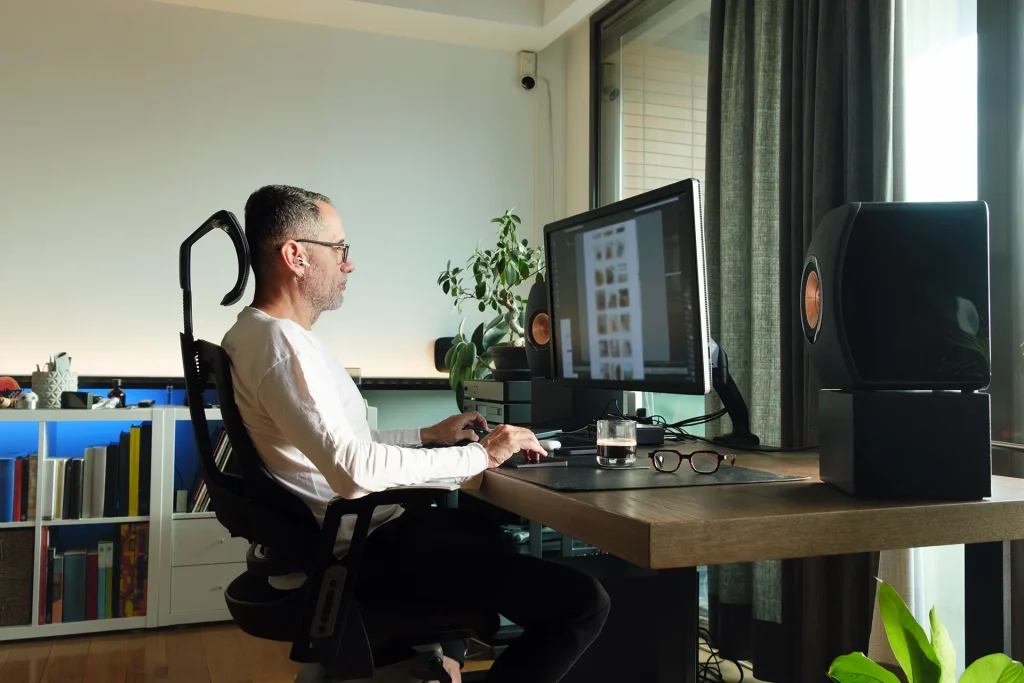
Elevating your monitor to eye level does two things: it helps your posture, and it clears the desk surface underneath for a cleaner visual line. A sleek desk design almost always includes a monitor at eye level rather than flat on the desk. If you have a laptop, a stand plus an external keyboard creates the same open, airy look.
The 80% Rule for Desk Surfaces
Keep at least 80% of your desk surface clear at all times. This one rule, taken seriously, will transform how your workspace looks and feels. If something migrates to your desk during the day, put it away at the end of your session. Make it a ritual. Clears the space, clears the mind.
Minimalist Storage Solutions That Hide the Clutter
Here’s the thing about minimalism that nobody warns you about: the stuff doesn’t disappear. You still have a printer. You still have a stack of papers. You still have 47 charging cables even after you told yourself you were going to minimize. The goal isn’t to eliminate these things — it’s to make them invisible.
Closed vs. Open Shelving
This is the most important storage decision in a minimalist home office. Closed cabinets are almost always the right call for anything that isn’t curated. Open shelving looks gorgeous in design photos, but in real life it becomes a surface for things to pile up on. Unless you’re committed to keeping those shelves styled with intention, go closed.
That said, open floating shelves above a desk — with a few books, a plant, and maybe one small framed print — can be the finishing touch that makes a workspace feel complete rather than sterile.
Vertical Storage: Your Best Friend in a Small Space
- Floating shelves above the desk — use the wall, not the floor
- Tall, narrow bookcases along one wall — vertical lines make ceilings feel higher
- Wall-mounted file organizers for paper management (gone are the days of stacked trays)
- Pegboards with baskets and hooks — surprisingly beautiful in a monochrome or industrial setup
Paper Management (the Silent Killer of Clean Desks)
Paper is the enemy of the organized workspace. A simple system makes all the difference:
- Inbox tray (hidden in a drawer or closed cabinet) — for things that need action
- Active files folder — current projects only, thin and contained
- Scan and shred policy — if it can be digitized, it should be
- Archive box — in a closet, not on your desk
Neutral Bins, Baskets, and Drawer Organizers
When storage containers are visible, they should match the palette. Neutral-toned linen bins, rattan baskets, or matte concrete-look organizers blend into a minimalist workspace without demanding attention. Matching your storage accessories to your color scheme makes the room feel cohesive even when it’s technically full of stuff.
Multi-Functional Desks with Built-In Storage
If you’re buying a new desk, look for one with built-in drawers or cable management. A desk with a hidden drawer cuts down enormously on the number of separate storage pieces you need. Functional office furniture that serves double duty is the cornerstone of a clutter-free workspace.
Neutral Color Palettes and Materials for a Calm Workspace
Color choices in a home office do more work than most people realize. I painted one office a deep navy blue thinking it would feel focused and sophisticated. What it actually felt was claustrophobic. Lesson learned.
For a minimalist home office, the goal is a palette that recedes — so your work can come forward.
The Best Minimalist Color Schemes
| Color / Tone | Mood It Creates | Best Paired With |
| Crisp White | Bright, airy, expansive | Natural wood, black accents |
| Soft Gray | Calm, neutral, professional | White trim, warm wood tones |
| Warm Beige / Greige | Cozy, grounded, inviting | Cream textiles, oak furniture |
| Muted Earth Tones (terracotta, dusty sage) | Organic, calming, distinctive | Linen, raw wood, woven textures |
| Matte Black (accent) | Bold, grounding, sophisticated | White walls, light wood |
The Role of Natural Wood
In almost every minimalist style — Scandinavian, Japandi, cozy minimal, even industrial — a wood desk aesthetic brings warmth that prevents the space from feeling clinical. Light wood (birch, ash, pine) works in bright, airy setups. Medium wood (oak, maple) is the most versatile. Dark wood (walnut, ebony stain) creates a moodier, more grounded feel.
Whatever you choose, keeping the wood finish consistent — desk, shelves, and accessories — ties the room together without effort.
Matte vs. Glossy: The Finish Question
Matte finishes almost always win in a minimalist home office. Glossy surfaces pick up fingerprints, reflect glare from your monitor or windows, and make a space feel more retail showroom than personal workspace. Matte black, matte white, and matte natural wood tones are the holy trinity of minimalist office materials.
Minimal Wall Art Without Overthinking It
One or two pieces of minimal wall art can complete a workspace without cluttering it. The rule: choose pieces with significant white space, thin frames, and a muted palette. Abstract line art, typographic prints in neutral tones, and simple botanical illustrations all work beautifully. Gallery walls, however beautifully executed, tend to feel visually noisy in a workspace — save those for the living room.
Lighting Ideas for a Bright and Airy Minimalist Home Office
Lighting is the most underrated element in home office design. Get it wrong and you’ll end up squinting at your screen by 3pm with a headache that you’re blaming on work when really it’s the ceiling fixture from 2009.
Start with Natural Light
Maximizing natural light is the single most impactful thing you can do for a minimalist home office. Natural light improves mood, reduces eye strain, and makes spaces look dramatically better in person and on video calls. If you’re choosing between two rooms, always pick the one with better windows, even if it’s slightly smaller.
For window treatments in a workspace:
- Sheer curtains — diffuse harsh direct light while keeping the room bright
- Roller blinds in off-white or natural linen — clean, minimal look, adjustable
- Top-down shades — let in light from the top while blocking glare at screen level
- Avoid heavy drapes in a workspace — they absorb light and make rooms feel smaller
The Layered Lighting Strategy
Even the best-lit room needs a layered artificial lighting approach for evenings and overcast days. A good minimalist setup has three layers:
- Ambient light — the room’s base light level (overhead fixture or wall sconces)
- Task light — your desk lamp, focused on your work surface
- Accent light — optional, but a small LED strip behind a monitor or a warm bulb in a corner can make a space feel intentional and cozy
Choosing the Right Desk Lamp
For a minimalist workspace, your modern desk lamp should disappear when it’s not the focus — meaning a slim, simple silhouette in a neutral tone. Matte black and brushed brass are both classics. Look for:
- Adjustable arm — so you can direct light exactly where you need it
- Warm-to-cool color temperature adjustment — warm (2700–3000K) for evening, cool (4000–5000K) for focus sessions
- Low-glare diffuser — bare LED bulbs are harsh; a good shade makes a real difference
- USB charging port built in — removes one plug from your cable situation
Warm vs. Cool Light Temperature
Use cool, daylight-balanced light during peak work hours and shift to warmer tones in the evenings. Cooler light (around 5000K) mimics daylight and supports alertness and focus. Warmer light (2700K) is more relaxing and better suited to winding down after hours. A lamp with a tunable color temperature — or just two separate lamps — handles both beautifully.
Avoiding Bulky Lighting Fixtures
Ceiling fans with integrated light kits, oversized pendant shades, or ornate chandeliers all fight against a minimal aesthetic. In a home office, the lighting should serve the work, not command the room’s attention. Recessed LED fixtures, sleek flush-mount ceiling lights, or wall sconces with a simple shade keep the overhead lighting clean and out of the way.
Ready to Build Your Minimalist Home Office?
A minimalist home office is more than a design trend — it’s a strategy for clarity and focus. The inspiration you’ve seen here, layered with smart layout decisions, intentional storage, a calm color palette, and the right lighting, comes together into something that works as hard as you do.
But here’s the part most design guides skip: the gear matters too. A beautiful desk with the wrong chair will destroy your posture and your mood within a week. A stunning setup with a lamp that casts the wrong light temperature will give you eye strain you’ll blame on the monitor. The physical tools in your workspace are just as important as the aesthetics around them.
The good news: you don’t have to figure it all out from scratch.
Browse tested, curated gear for your minimalist setup →
Our Office Furniture Gear Reviews break down the best desks, storage units, and workspace essentials we’ve actually used — with honest takes on what’s worth the investment and what’s all looks and no substance.
And if you’re still sorting out the chair situation (possibly the most important piece of furniture you’ll ever buy for your home office), our Best Ergonomic Office Chair guide compares the top options across every budget level.
→ See All Office Furniture Reviews at Focus Mode HQ
Use this guide as your starting point. Save the styles that resonate most. Build your minimalist office around functionality first — and let the aesthetics follow. The result is a workspace that actually helps you do your best work, every day.

Sophia Carter has spent years testing productivity tools and workspace setups. She helps remote workers build efficient home offices that support deep focus, ergonomics, and better workflows.